
News
2026/ 1 / 9
Breaking New Ground: "Green Intelligent Manufacturing" Leads High-End Transformation of China's Steel Industry
A roll of 0.07mm “cicada-wing steel” reflects a metallic sheen under the spotlight. This remarkably thin material can withstand astonishing pressure—a testament to the Shougang R&D team’s breakthrough in thickness limits and a microcosm of the Chinese steel industry’s shift from scale expansion to quality breakthroughs.
In 2024, steel demand from the manufacturing sectors—including automotive, shipbuilding, and new energy—accounted for 50% of total demand, sharing equal ground with construction steel for the first time.
The steel industry is undergoing a structural transformation from traditional construction steel to high-end manufacturing steel. Baosteel’s ultra-low carbon emission steel can reduce carbon emissions by 60% per ton, and an area the size of a coin can bear the weight of two elephants.
01 Product System and Innovative Breakthroughs
China’s steel product system has evolved into two main categories: carbon steel and stainless steel. Carbon steel excels in toughness, while stainless steel offers superior rigidity, with both material systems playing distinct roles across manufacturing industries.
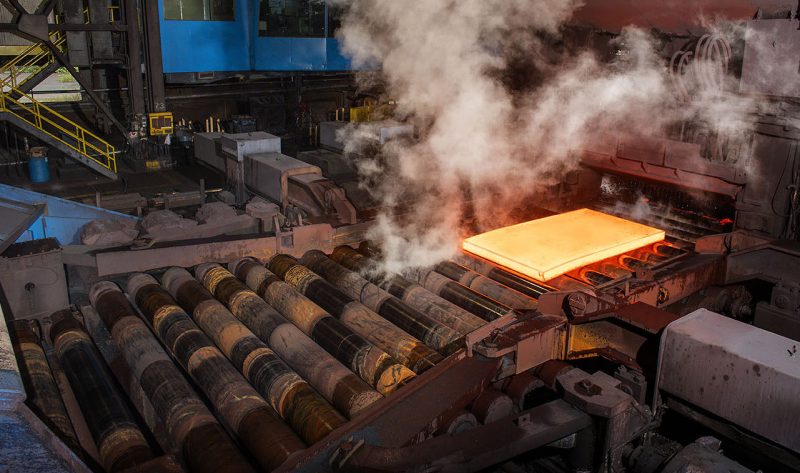
These products undergo upstream steel smelting and midstream rolling processes before becoming various finished products for machinery, automotive, construction, and other sectors.
Innovation in the steel industry manifests across multiple dimensions. Enterprises continuously push the boundaries from thickness to strength. Shougang’s “cicanda-wing steel” can now reach a thickness of 0.07mm—thin as paper yet maintaining excellent performance.
In April 2025, HBIS Group’s Handan Company achieved a domestic first with the development of a corrosion-resistant cold-rolled hot-formed steel boasting a tensile strength of 1500MPa, filling a gap in this field.
Concurrently, Taihang Steel successfully rolled the world’s thinnest 0.9mm patterned plate, setting a new industry record.
02 R&D Progress and Technological Frontiers
The steel industry’s R&D pace is accelerating. In April 2025, major steel enterprises made significant strides toward high-end and low-carbon development. Benxi Steel Group successfully developed and began mass production of 20MnCrS5-2 gear steel, supplying it to a renowned German transmission manufacturer.
Xiangtan Steel successfully developed a copper-steel clad plate, becoming China’s first steelmaker to master full-process copper-steel rolling composite technology. Guangxi Steel’s No.3 Slab Caster successfully produced a 400mm thick slab, filling the void for this specification.
Product R&D has taken on systematic characteristics. Baosteel Special Steel has established three core series—special metallurgy, stainless steel, and structural steel—focusing on key sectors like aerospace, energy, and automotive transportation.
The company is equipped with internationally advanced smelting facilities such as vacuum induction furnaces, electroslag furnaces, and vacuum consumable furnaces, providing hardware assurance for high-end product development.

03 Green Manufacturing and Low-Carbon Transition
Green manufacturing in the steel industry is evolving along multiple technological pathways. The electric arc furnace (EAF) steelmaking process is regarded as a primary “green manufacturing” technical route. By November 2025, 84 EAFs across 51 EAF enterprises had completed and publicized their ultra-low emission transformation.
The low-carbon transition is no longer limited to end-of-pipe treatment but encompasses technological innovation across the entire industrial chain. During the “14th Five-Year Plan” period, the steel industry promoted the high-end development of basic steel for automotive and home appliance sectors, giving rise to key technologies like “ecological non-blast furnace ironmaking” and the “third-generation TMCP (Thermo-Mechanical Controlled Process).”
Novel low-carbon processes such as hydrogen-based shaft furnace direct reduction and blast furnace hydrogen-enriched smelting are accelerating within the industry. HBIS Group has taken the lead in formulating the group standard “Design Code for Hydrogen-Based Shaft Furnace Direct Reduction Process.”
04 Market Restructuring and Industry Evolution
The steel industry is undergoing profound market restructuring. In 2024, the proportion of steel used in China’s construction sector fell to 50%. Simultaneously, demand for steel in the manufacturing sector maintained growth, its share rising from 42% in 2020 to 50% in 2024.
Steel consumption in the automotive sector increased by 1.8% year-on-year, while the home appliance sector saw a 9.1% year-on-year growth, becoming significant drivers of demand growth.
In response to market changes, steel enterprises are transforming into service-oriented, customized product suppliers, actively establishing joint product R&D and application laboratories with downstream customers.
Tangsteel has established steel processing and distribution centers in Tianjin, Jilin, Zhejiang, and other locations, selling steel after shearing and processing, providing customers with more convenient and precise services.
05 Future Directions and Industrial Upgrade Pathways
The future upgrade of the steel industry presents diversified pathways. The sector will focus on researching downstream product demand within the sales radius of EAF short-process enterprises, building regional databases of downstream requirements.
Wang Juan, Vice President of Baoshan Iron & Steel Co., Ltd., stated that the company closely monitors high-end manufacturing, strengthens originality and leadership, develops high-end products including ultra-high-strength steel and grain-oriented silicon steel, and continuously researches and reserves even more advanced new material technologies.
Industrial upgrade paths also include differentiated product layouts and scaled operations. EAF short-process enterprises can achieve group-based, scaled operations through various means such as capacity transfer, mergers, and acquisitions.
Enterprises belonging to different groups within the same region can adopt collaborative models to achieve product differentiation as much as possible.
Ma Steel produced P92 steel for ultra-supercritical units with a diameter of 1000mm on a curved continuous caster for the first time, solving two major industry challenges—”high-temperature ferrite control technology” and “center and surface quality control technology”—with the product filling a domestic gap.
Steel products are no longer just cold industrial raw materials. They are the technological breakthroughs supporting Grade F thick offshore engineering steel entering the Waigaoqiao Shipyard, enabling “hand-tearing steel” to become art, and allowing new energy vehicle wheels to lose weight without compromising safety.
A path of steel, stretching from construction sites to smart manufacturing factories, is redefining the weight and value of “Made in China.”
Contact Us
Address
High-tech Industrial Development Zone, Zhengzhou City, Henan Province, China.
jean@ji-steel.com
Phone
+86 188 3804 2177
Products
- Continuous Casting
- ● Copper Mould Tube
- ● Mould Assembly
- ● Ladle And Tundish Nozzle
- Steel Melting
- ● Graphite Electrode
- ● CPC/GPC
- ● Continuous Casting Protecting Slag
- ● Furnace Lining Vibrator
- Rolling Mill Equipment
- ● Steel Roll
- ● Tungsten Carbide Roll Ring
- ● Rolling Mill Guides
- ● Roller Table
Contact
- jean@ji-steel.com
- +86 371 6781 0168
- +86 188 3804 2177
- +86 188 3804 2177
- www.ji-steel.com
- High-tech Industrial Development Zone, Zhengzhou City, Henan Province, China.